

If you’re using a metabolic patch for the first time, one of the most common questions is where it should be applied. While ingredients often receive the most attention, proper placement can play an important role in comfort, adhesion, and overall day-to-day usability.
Different patch manufacturers may provide different instructions, so it’s always important to follow the directions included with your specific product. However, there are several commonly recommended application areas that many users find practical and comfortable.
If you’re new to metabolic patches, you may also want to start with our Metabolic Patch Guide, which explains how these products work, what to expect, and important safety considerations.
Why Proper Placement Matters
✓ Better Adhesion
May help the patch stay attached throughout the recommended wear period.
✓ Less Friction
Choosing suitable locations may reduce rubbing from clothing.
✓ More Comfort
Many users find certain application areas more comfortable for daily wear.
✓ Consistent Use
Comfortable placement may support more consistent patch use.
For most users, the goal is to find a clean, dry area of skin that allows the patch to remain comfortably in place for the recommended wear period.
Common Areas Where Metabolic Patches Are Applied
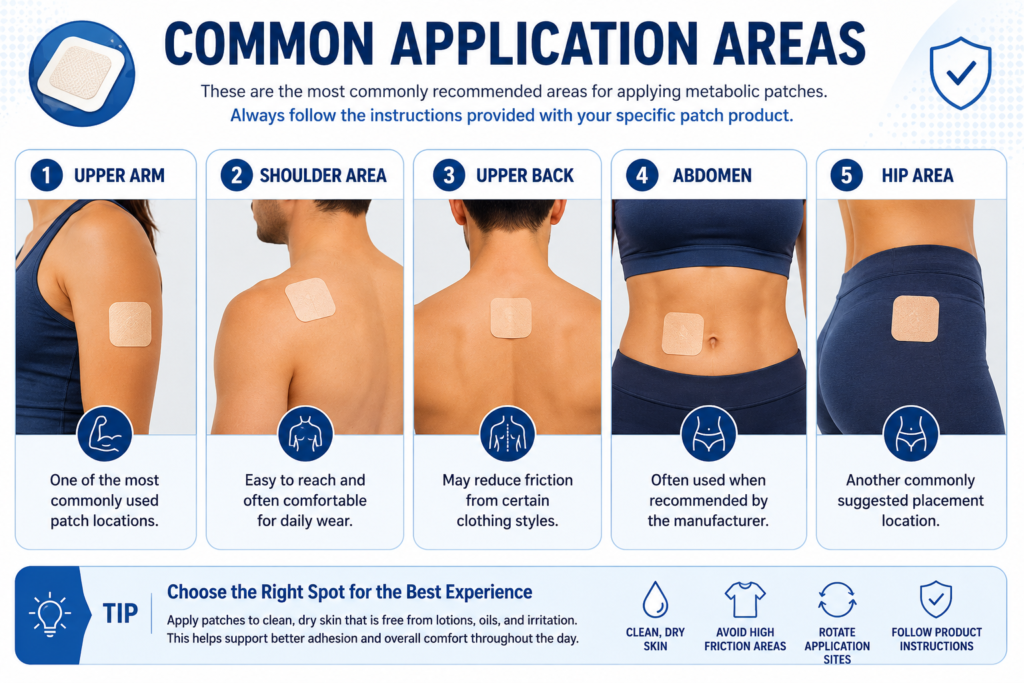
These locations are often selected because they provide relatively flat surfaces and may experience less friction than certain other body areas.
Areas To Avoid
- ⚠ Broken or damaged skin
- ⚠ Active rashes or irritation
- ⚠ Recently shaved sensitive areas
- ⚠ High-friction locations
- ⚠ Excessively sweaty areas
Applying patches to irritated or compromised skin may increase discomfort and reduce usability.
If you have sensitive skin or have experienced redness from adhesive products before, you may also find our guide on skin irritation and metabolic patches helpful.
Should You Rotate Application Sites?
Many patch users choose to rotate application sites rather than repeatedly placing patches in exactly the same location.
Rotating sites may help:
- Reduce skin irritation.
- Improve comfort.
- Allow the skin time to recover between applications.
- Reduce repeated stress on a single area.
If you notice redness or sensitivity, consider allowing that area to rest before using it again. You can also learn more in our article on long-term metabolic patch safety.
How To Apply A Metabolic Patch Correctly
Proper application can help improve the user experience and reduce the likelihood of the patch falling off prematurely.
A general application process may include:
- Wash and dry the area thoroughly.
- Avoid lotions, oils, or moisturizers before application.
- Remove the patch backing.
- Apply the patch firmly to the chosen location.
- Press gently for several seconds to help secure adhesion.
For more detailed instructions, see our guide on How to Use Metabolic Patches Correctly.
Does Placement Affect Results?
This is one of the most frequently asked questions among new patch users.
At present, consumers should avoid assuming that moving a patch to a different location will automatically improve results. The best approach is to follow the manufacturer’s instructions and use the patch as directed.
Different patch designs may have different placement recommendations, and there is generally limited evidence supporting the idea that random alternative locations produce better outcomes.
Consistency and proper use are typically more important than searching for a “perfect” placement location.
5 Common Patch Application Mistakes
Applying patches before skin is fully dry.
Moisturizers may reduce adhesion.
May make patches harder to keep attached.
Avoid applying over redness or damaged skin.
Always follow manufacturer guidance.
Questions about daily activities are also common. For example, many users want to know whether they can shower with a metabolic patch or sleep while wearing a patch.
Final Thoughts
Choosing the right location for a metabolic patch can help improve comfort, adhesion, and overall ease of use.
While manufacturers may recommend different placement locations, common application areas often include the upper arm, shoulder, upper back, abdomen, and hip area.
Most importantly, follow product instructions carefully, apply patches to clean and dry skin, and avoid irritated areas whenever possible.
If you’re continuing your research, we recommend reading our guides on proper patch use, patch safety, and our complete Metabolic Patch Guide.
Proper placement won’t guarantee specific results, but it can help create a more comfortable and consistent patch-wearing experience.
FAQ
Where should you apply metabolic patches?
Common application areas may include the upper arm, shoulder, upper back, abdomen, or hip area depending on the manufacturer’s instructions.
Can you apply a metabolic patch to your stomach?
Some manufacturers allow abdominal placement, but users should always follow the directions supplied with their specific patch.
Can you wear a patch on your arm?
Yes. The upper arm is one of the most commonly recommended patch locations.
Does patch placement affect results?
Consumers should follow manufacturer recommendations and avoid assuming that alternative locations automatically improve outcomes.
Should you rotate patch locations?
Many users rotate locations to improve comfort and reduce the possibility of skin irritation.
Can you place patches over body hair?
Heavy body hair may reduce adhesion. Many users prefer smoother skin areas when possible.
What happens if a patch falls off?
Follow the instructions supplied by the manufacturer. Some products may require replacement while others may provide specific guidance.
Can you apply a patch after showering?
Yes, provided the skin is completely dry before application.
Can you wear multiple patches?
Only use patches according to the manufacturer’s instructions.
How long should a patch stay on?
Wear time varies between products. Always follow the instructions included with the patch.
Learn How To Use Metabolic Patches Properly
Correct placement is only one part of using a patch successfully. Understanding wear times, application techniques, safety considerations, and realistic expectations can help you make more informed decisions.

Reviewed for Accuracy & Transparency
This page was reviewed for factual accuracy, source quality, safety wording, affiliate transparency, and alignment with our editorial policy. It is not medical advice and should not replace guidance from a qualified healthcare professional.
Written by The Metabolic Patch Editorial Team
The Metabolic Patch Editorial Team researches metabolic wellness patches, ingredient claims, product safety considerations, pricing, refund policies, and affiliate transparency. Our goal is to help readers make informed decisions using evidence-informed, clearly sourced, and commercially transparent content.
Affiliate Transparency
Some links on this page may be affiliate links. If you purchase through these links, The Metabolic Patch may earn a commission at no extra cost to you. Our reviews are designed to remain evidence-informed, safety-conscious, and transparent.
Important Safety Note
Dietary supplements and wellness patches are not intended to diagnose, treat, cure, or prevent disease. If you are pregnant, breastfeeding, taking medication, managing a medical condition, or have sensitive skin, speak with a qualified healthcare professional before using any new supplement or patch product.
References & Educational Sources
This article is intended for educational purposes and discusses general patch placement practices. Always follow the instructions provided with your specific product.