
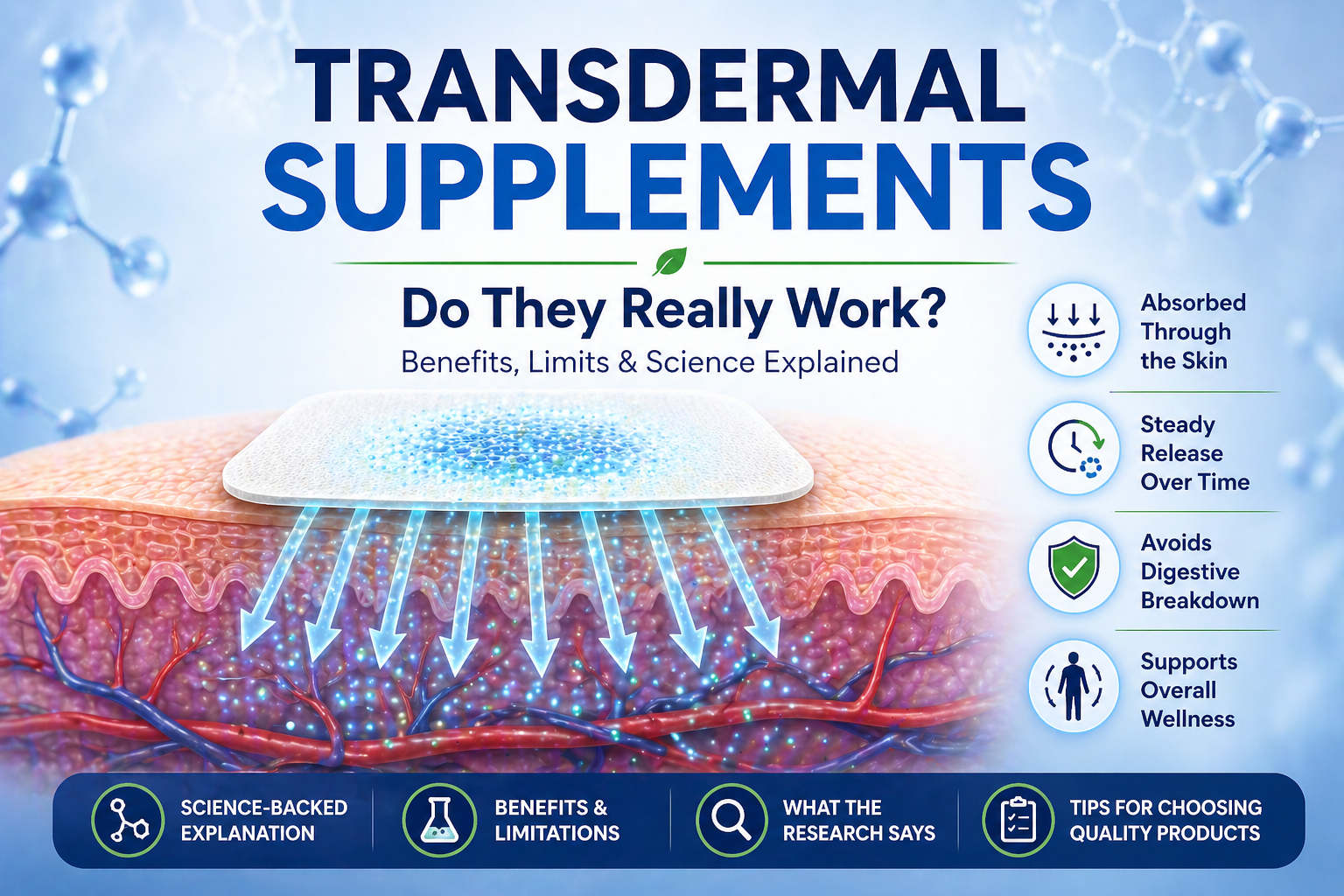
What Are Transdermal Supplements?
Transdermal supplements are products designed to deliver active ingredients through the skin rather than through the digestive system. These typically come in the form of: patches, creams, and gels. The goal is to allow nutrients or compounds to pass through the skin and enter the bloodstream gradually. If you’re specifically interested in berberine-based patches, see: 👉 Berberine Patches: Benefits, Limits, Safety & Buying Guide
How Do Transdermal Supplements Work?
Transdermal supplements rely on absorption through the skin. When applied, active compounds are released and attempt to pass through the outer skin barrier (stratum corneum), then into deeper layers and eventually into circulation. For a detailed breakdown of how this applies to berberine: 👉 How Berberine Patches Work: Transdermal Delivery Explained
The Science Behind Transdermal Absorption
The skin is designed to protect the body, which means absorption can be challenging. For a substance to pass through the skin effectively, it generally needs the right size, solubility, and delivery formulation.
Smaller compounds generally have a better chance of passing through the skin barrier.
Ingredients may need both water- and fat-soluble properties to move through skin layers.
The delivery system matters. A patch is only as useful as the formulation behind it.
Types of Transdermal Products
1. Patches
Deliver a steady, controlled dose over time.
2. Creams and Gels
Applied directly and absorbed more quickly, but less controlled.
3. Medicated Systems
Used in pharmaceuticals (e.g., nicotine patches, hormone therapy).
Potential Benefits vs Limitations
Transdermal supplements may offer convenience, but they are not automatically better than oral supplements. Effectiveness depends on the ingredient, formulation, and consistency of use.
- May avoid digestive breakdown
- Can offer steady release over time
- Convenient for people who dislike pills
- May reduce gastrointestinal discomfort for some users
- Skin absorption can be limited
- Results may vary between people
- Research is limited for many supplement ingredients
- Product quality and delivery systems can differ widely
Bottom line: Transdermal supplements may be useful in certain situations, but they are not universally reliable for every ingredient.
Do Transdermal Supplements Actually Work?
The answer is: it depends on the compound and the formulation. Some substances are well suited for transdermal delivery, while others are not. In the case of supplements like berberine: the compound itself has strong research, but the delivery method is still being studied.
Transdermal vs Oral Supplements
Both delivery methods have advantages, but they work differently. Here is a simple comparison.
Transdermal Supplements
- Absorption: Variable
- Research: Limited for many ingredients
- Convenience: High
- Side effects: May reduce GI discomfort
Oral Supplements
- Absorption: More predictable
- Research: Stronger overall
- Convenience: Moderate
- Side effects: Possible GI discomfort
Bottom line: Transdermal supplements may be more convenient, but oral supplements usually have stronger research and more predictable dosing. Effectiveness depends on the ingredient and the formulation.
Are Transdermal Supplements Safe?
In general, transdermal systems are considered safe when properly formulated. However, possible concerns include: skin irritation, allergic reactions, and incorrect use. For berberine-specific safety: 👉 Are Berberine Patches Safe? What to Know Before Use
Who Should Consider Transdermal Supplements?
People who dislike pills, those with digestive sensitivity, and individuals seeking steady-release options.
Who Should Be Cautious?
People with sensitive skin, those taking medications, and individuals with chronic conditions.
What to Look for in a Quality Transdermal Supplement
Transparent ingredient list, evidence-based formulation, reputable manufacturer, and realistic claims.
Do Transdermal Supplements Work?
Transdermal supplements can be effective in certain situations, but they are not universally reliable for every compound. Their success depends heavily on the formulation, ingredient type, and consistency of use.
Simple takeaway: Transdermal delivery may be convenient, but the product still needs the right ingredient, the right delivery system, and realistic expectations.
Related Articles
Frequently Asked Questions About Transdermal Supplements
Do transdermal supplements really work?
Transdermal supplements may work when the ingredient is suitable for skin absorption and the product uses an effective delivery system. However, not all nutrients absorb well through the skin, so results depend heavily on formulation quality.
Are transdermal supplements better than pills?
Not always. Pills usually have stronger clinical research and more predictable dosing. Transdermal supplements may be better for people who dislike capsules or experience digestive discomfort from oral supplements.
How do transdermal supplements absorb through the skin?
They release active ingredients onto the skin, where the compounds attempt to pass through the outer skin barrier and into deeper layers. From there, some ingredients may enter circulation over time.
What are the benefits of transdermal supplements?
Potential benefits include convenience, steady release, avoiding digestion, and reduced gastrointestinal discomfort compared with some oral supplements.
What are the limitations of transdermal supplements?
The main limitations are variable absorption, limited research for many ingredients, skin irritation risk, and differences in product quality.
Are transdermal supplements safe?
They may be safe for many people when used as directed, but possible concerns include adhesive irritation, allergic reactions, or interactions with medications depending on the ingredient used.
Who should avoid transdermal supplements?
People with sensitive skin, allergies to adhesives, underlying medical conditions, or those taking medication should be cautious and speak with a healthcare professional before use.
How long do transdermal supplements take to work?
Most transdermal supplements are not designed for instant results. If benefits occur, they usually depend on consistent use over several weeks and may vary between individuals.
Are supplement patches the same as medical patches?
No. Medical patches are regulated drug-delivery systems, while supplement patches are wellness products. The evidence and quality standards can vary significantly between products.
What should I look for in a quality transdermal supplement?
Look for a transparent ingredient list, realistic claims, reputable manufacturing, clear instructions, and a delivery system designed specifically for skin absorption.
Compare the Best Transdermal Patch Options
Review top berberine patch options based on ingredients, safety considerations, pricing, and realistic expectations before choosing.
View Top Berberine Patches →
Reviewed for Accuracy & Transparency
This page was reviewed for factual accuracy, source quality, safety wording, affiliate transparency, and alignment with our editorial policy. It is not medical advice and should not replace guidance from a qualified healthcare professional.
Written by The Metabolic Patch Editorial Team
The Metabolic Patch Editorial Team researches metabolic wellness patches, ingredient claims, product safety considerations, pricing, refund policies, and affiliate transparency. Our goal is to help readers make informed decisions using evidence-informed, clearly sourced, and commercially transparent content.
Important Safety Note
Dietary supplements and wellness patches are not intended to diagnose, treat, cure, or prevent disease. If you are pregnant, breastfeeding, taking medication, managing a medical condition, or have sensitive skin, speak with a qualified healthcare professional before using any new supplement or patch product.
Affiliate Transparency
Some links on this page may be affiliate links. If you purchase through these links, The Metabolic Patch may earn a commission at no extra cost to you. Our reviews are designed to remain evidence-informed, safety-conscious, and transparent.