
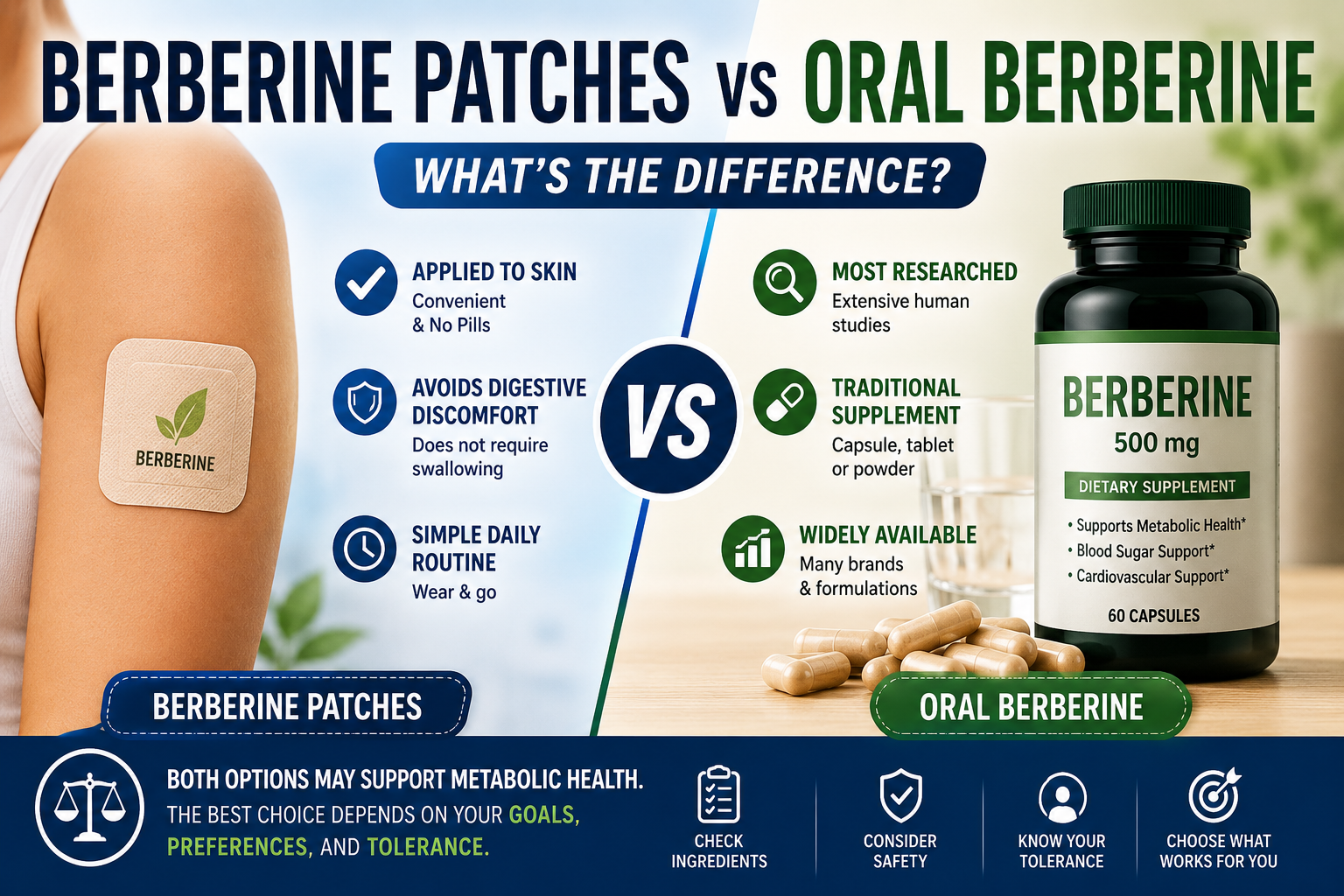
Berberine has become increasingly popular among people researching metabolic health, blood sugar support, cholesterol, appetite, and weight management. Traditionally, berberine has been taken as a capsule, tablet, or powder. More recently, berberine patches have appeared as a convenient alternative for people who prefer not to swallow supplements.
Although both products may contain or advertise berberine, they should not be treated as equivalent delivery methods. Oral berberine has been evaluated in numerous human studies, while direct research on commercially available berberine patches remains much more limited.
The most important difference is therefore not simply whether one is swallowed and the other is placed on the skin. Consumers should also compare the evidence supporting absorption, the ingredient amount, product transparency, possible side effects, and whether the delivery system has been properly tested.
If you are new to this category, begin with our complete Berberine Patches Guide or the broader Metabolic Patch Guide.
Quick Answer
Berberine patches and oral berberine supplements both provide berberine, but they use different delivery methods. Oral berberine has substantially more clinical research, while patches are often chosen for convenience and to avoid swallowing capsules.
Convenient • No pills • Skin-applied
Most researched • Capsule format • Traditional supplement
Depends on convenience, digestive tolerance, and personal preference.
What Is Oral Berberine?
Oral berberine is usually sold as a capsule, tablet, liquid, or powder. After it is swallowed, the product enters the gastrointestinal tract and is processed through the digestive system.
Oral berberine has been studied in relation to several metabolic outcomes, including blood glucose, insulin resistance, blood lipids, and body-composition measurements. However, study quality, formulations, doses, participant groups, and treatment durations have varied considerably.
The National Center for Complementary and Integrative Health notes that there is not yet enough rigorous clinical evidence to determine whether berberine is effective for weight loss. It should not be viewed as an established replacement for medical weight-management treatment.
Oral berberine also has relatively low bioavailability, meaning only a limited proportion of an ingested amount may reach the bloodstream unchanged. This does not mean oral berberine has no biological activity, but it helps explain why researchers continue to investigate its absorption, metabolism, dose, and formulation.
What Are Berberine Patches?
Berberine patches are adhesive wellness products placed on the skin. They are commonly marketed as a convenient or transdermal way to use berberine without swallowing a capsule.
A genuine transdermal delivery system must do more than place an ingredient against the skin. The ingredient must be released from the patch, cross the skin barrier, remain stable, and reach the body in a measurable and useful amount.
Approved pharmaceutical patches are developed and tested for factors such as ingredient release, adhesion, stability, dose uniformity, skin response, and pharmacokinetics. The existence of proven prescription patches does not automatically establish that every supplement patch can deliver its advertised ingredients effectively.
Direct human evidence demonstrating the absorption and clinical effectiveness of commercially available berberine patches remains limited. This is why claims based on oral berberine research should not automatically be transferred to a patch product.
For a closer look at the delivery concept, read How Berberine Patches Work.
Berberine Patches vs Oral Berberine
Both formats may feature berberine, but they differ significantly in how they are used, the strength of the supporting evidence, and the practical issues users should consider.
| Feature | Berberine Patch | Oral Berberine |
|---|---|---|
| How It Is Used | Applied to clean, dry skin for the recommended wear period. | Swallowed as a capsule, tablet, liquid, or powder. |
| Convenience | No swallowing and may fit easily into a daily routine. | Familiar supplement format but may require multiple servings. |
| Digestive Contact | Does not require an oral dosage form to pass through the digestive tract. | Passes through the digestive system and may cause gastrointestinal effects. |
| Scientific Evidence | Direct product-specific absorption and clinical research remain limited. | Substantially more human research is available for oral preparations. |
| Dose Comparison | The amount contained in a patch may not equal the amount delivered through the skin. | The swallowed amount is normally stated clearly on the label. |
| Possible Side Effects | May include redness, itching, adhesive sensitivity, or irritation. | May include nausea, constipation, diarrhoea, bloating, or abdominal discomfort. |
| Main Limitation | Uncertainty about reliable transdermal absorption and dose delivery. | Digestive effects, low oral bioavailability, and possible medication interactions. |
Best understood as a convenient, no-pill format with limited patch-specific clinical evidence.
Has the stronger human evidence base but may cause digestive side effects in some users.
Which Option Has More Scientific Evidence?
Oral berberine currently has the stronger evidence base because most published human research has examined capsules, tablets, or other oral preparations. If you’d like to understand why delivering ingredients through the skin presents different challenges, read our guide on How Berberine Patches Work.
Substantially more human studies covering metabolic markers, dosing, and possible adverse effects.
Limited direct evidence confirming consistent absorption from commercial patch products.
Research on swallowed berberine should not automatically be applied to skin-delivery products.
Do Berberine Patches Bypass The Digestive System?
A patch is applied externally and does not require swallowing, so it avoids direct passage through the stomach and intestines as a physical dosage form.
However, statements that a particular berberine patch “bypasses digestion” should not be interpreted as proof that the product successfully delivers berberine into the bloodstream. Effective transdermal delivery depends on the ingredient’s properties, patch formulation, skin penetration, adhesion, wear time, and product testing.
In other words, avoiding a capsule is a clear convenience benefit. Superior absorption is a separate claim that requires evidence.
Advantages and Limitations
Each format has practical strengths, but neither is perfect. Compare convenience, evidence, side effects, and dose transparency.
Berberine Patch Advantages
- No capsules to swallow
- Simple daily application
- Discreet under clothing
- May suit users who dislike powders or tablets
Berberine Patch Limitations
- Limited patch-specific human evidence
- Uncertain transdermal dose delivery
- Possible skin irritation
- Adhesion may be affected by water or friction
Oral Berberine Advantages
- Used in most human research
- Amount per serving usually stated
- Widely available
- Easier to compare with published studies
Oral Berberine Limitations
- May cause digestive side effects
- Relatively low oral bioavailability
- Capsules may be inconvenient
- May interact with medications
For practical patch guidance, see where to apply metabolic patches and what happens if a patch is worn too long.
Which May Cause More Side Effects?
The two formats tend to cause different types of problems rather than one being universally safer.
Patch-Related Effects
- Redness or itching
- Burning or discomfort
- Adhesive sensitivity
- Peeling or residue
- Friction-related irritation
Oral-Berberine Effects
- Abdominal discomfort
- Nausea
- Constipation
- Diarrhoea
- Vomiting
Read more about skin irritation from berberine patches.
Can Berberine Interact With Medications?
Yes. Berberine may interact with medicines by affecting enzymes, transporters, blood glucose, blood pressure, or other physiological processes.
Extra caution is warranted for people taking medication for diabetes, blood pressure, blood clotting, immune suppression, or other chronic conditions. Combining berberine with glucose-lowering medication may require professional supervision because of the possibility of additive effects.
Speak with a qualified healthcare professional or pharmacist before using either oral berberine or a berberine patch if you take prescription medication, manage a health condition, or use several supplements.
Who Should Avoid Berberine?
Berberine is generally considered inappropriate during pregnancy and breastfeeding, and it should not be given to infants. It has been associated with a risk of harmful bilirubin accumulation in newborns.
People with medical conditions, people preparing for surgery, and anyone taking prescription medication should seek professional advice before use.
For broader guidance, read Who Should Avoid Metabolic Patches?.
Which Format May Suit You?
A Patch May Appeal If You:
- Dislike swallowing capsules
- Prefer a skin-applied product
- Want a simple daily routine
- Understand patch-specific evidence is limited
- Have reviewed ingredients and instructions carefully
Oral Berberine May Appeal If You:
- Prefer the format used in most research
- Want a clearly stated amount per serving
- Are comfortable swallowing capsules
- Can tolerate digestive effects
- Want more brands and formulations to compare
Can You Use A Berberine Patch And Oral Berberine Together?
Do not combine the two simply because they use different delivery formats.
If a patch successfully delivers berberine, using it together with an oral supplement could increase total exposure. The difficulty is that the amount delivered by many commercial patches may not be clearly established.
Combining products may also increase the risk of side effects or medication interactions. Seek advice from a healthcare professional before using multiple berberine products together.
Can You Switch From Oral Berberine To A Patch?
A consumer can stop using one product and consider another, but there is no validated dose-conversion formula between oral berberine and most commercial berberine patches.
A patch labelled with a certain amount of berberine should not automatically be treated as equivalent to swallowing the same amount. The amount contained in a patch is not necessarily the amount released, absorbed through the skin, or delivered systemically.
Anyone using berberine for a medical reason should not change treatment or replace prescribed care without speaking with a qualified healthcare professional.
What Should You Check Before Buying?
Use this checklist before choosing either a berberine patch or an oral supplement.
Check every active and inactive ingredient.
Review the stated amount per capsule, serving, or patch.
Check frequency, timing, placement, and wear duration.
Review contraindications and medication interactions.
Look for manufacturing and independent-testing information.
Do not rely only on research involving other formulations.
Check refund terms, contact details, and company information.
Avoid guaranteed results or unsupported medical claims.
Which Is Better: Berberine Patches Or Oral Berberine?
Oral berberine is the better-supported option from a research perspective because it is the format used in most human studies.
Berberine patches may be more attractive from a convenience perspective, especially for consumers who dislike swallowing pills. Their main limitation is the lack of strong product-specific evidence demonstrating reliable transdermal absorption and clinical outcomes.
The right decision depends on the user’s priorities:
- Choose based on evidence: oral berberine has the advantage.
- Choose based on convenience: a patch may feel easier to use.
- Choose based on digestive tolerance: a patch avoids swallowing, but effective delivery still needs to be established.
- Choose based on measurable dosing: oral products are generally easier to compare.
- Choose based on safety: both require ingredient review and consideration of interactions.
Prefer Capsules Instead?
Looking for a High-Quality Berberine Capsule?
If you’ve decided that a traditional berberine supplement is a better fit than a patch, we’ve selected a premium berberine capsule that stands out for its quality, ingredient transparency, and overall value.
Whichever delivery method you choose, review the ingredients, dosage, safety information, and manufacturer’s instructions before purchasing or using any berberine product.
Choosing Between Berberine Patches & Oral Berberine
Although both products contain berberine, they should not be viewed as interchangeable. Oral berberine has the stronger clinical evidence, while patches may offer greater convenience for people who prefer not to swallow capsules.
Evidence
Oral berberine currently has substantially more published human research than commercial berberine patches.
Convenience
Patches may be easier for people who dislike swallowing pills, but convenience alone does not prove comparable absorption.
Safety
Both formats require attention to ingredients, potential interactions, and manufacturer instructions before use.
Continue Your Research
If you’re still comparing your options, these guides may help:
The most evidence-supported option isn’t always the most convenient, and the most convenient option isn’t automatically the most effective. Compare both the available evidence and the practicality of each delivery method before deciding.
Frequently Asked Questions
Are berberine patches better than oral berberine?
Not based on current evidence. Oral berberine has been studied much more extensively, while patches may offer greater convenience but have limited product-specific research.
Do berberine patches work the same as capsules?
This has not been established. A patch must demonstrate that it can release berberine and deliver a meaningful amount through the skin.
Are berberine patches absorbed through the skin?
They are marketed for skin-based delivery, but direct human absorption data for many commercial berberine patches are limited or unavailable.
Does oral berberine have better scientific evidence?
Yes. Most human studies and evidence reviews have examined orally administered berberine.
Do berberine patches avoid stomach side effects?
They do not require swallowing and therefore avoid direct gastrointestinal exposure to an oral dosage form. However, this does not prove that a patch delivers berberine effectively or eliminates all potential side effects.
Can oral berberine cause digestive problems?
Yes. Reported effects include abdominal discomfort, nausea, constipation, diarrhoea, and vomiting.
Can berberine patches irritate the skin?
Yes. The adhesive, patch materials, ingredients, friction, or extended wear may cause redness, itching, or irritation in some users.
Can you use a berberine patch and capsules together?
Do not combine them without professional advice. If both products deliver berberine, total exposure and the risk of adverse effects or interactions may increase.
Which format is easier to dose?
Oral products are generally easier to compare because the amount swallowed per serving is stated. The amount absorbed from a patch may be less certain without product-specific testing.
Who should avoid berberine?
Berberine should generally be avoided during pregnancy and breastfeeding and should not be given to infants. People taking medication or managing a medical condition should seek professional advice before use.
Continue Your Research
Compare Berberine Patch Options Carefully
Review how berberine patches work, compare current patch options, and understand the evidence, safety considerations, and realistic expectations before choosing a product.
Always review ingredients, usage directions, safety information, and product-specific evidence before purchasing.
References & Educational Sources
This article is intended for educational purposes and discusses berberine research, delivery formats, supplement safety, possible side effects, and evidence limitations. Research involving oral berberine should not automatically be treated as evidence for commercial transdermal patches.

Reviewed for Accuracy & Transparency
This page was reviewed for factual accuracy, source quality, safety wording, affiliate transparency, and alignment with our editorial policy. It is not medical advice and should not replace guidance from a qualified healthcare professional.
Written by The Metabolic Patch Editorial Team
The Metabolic Patch Editorial Team researches metabolic wellness patches, ingredient claims, product safety considerations, pricing, refund policies, and affiliate transparency. Our goal is to help readers make informed decisions using evidence-informed, clearly sourced, and commercially transparent content.
Affiliate Transparency
Some links on this page may be affiliate links. If you purchase through these links, The Metabolic Patch may earn a commission at no extra cost to you. Our reviews are designed to remain evidence-informed, safety-conscious, and transparent.
Important Safety Note
Dietary supplements and wellness patches are not intended to diagnose, treat, cure, or prevent disease. If you are pregnant, breastfeeding, taking medication, managing a medical condition, or have sensitive skin, speak with a qualified healthcare professional before using any new supplement or patch product.