
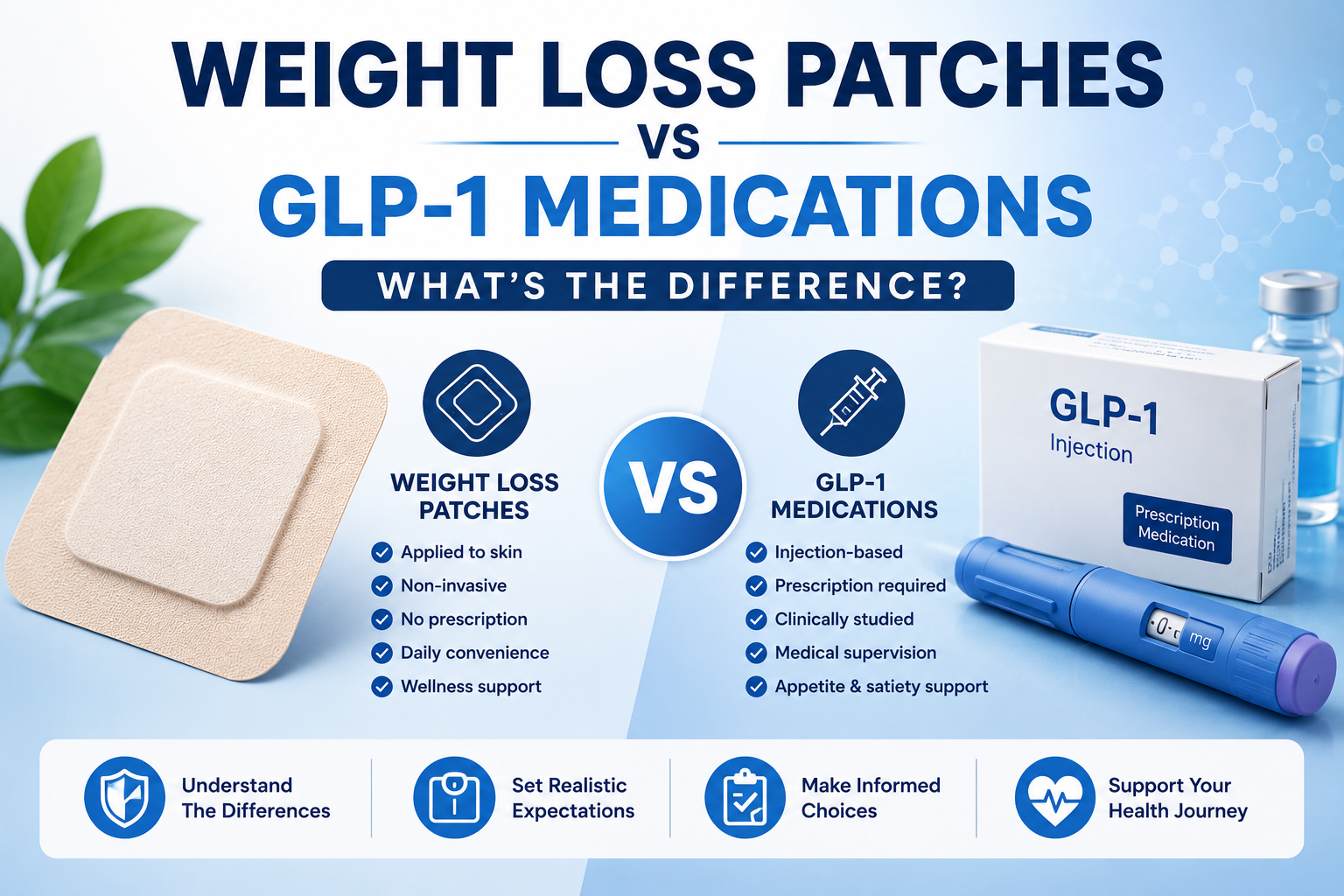
As interest in weight management continues to grow, many consumers are comparing weight loss patches with GLP-1 medications to understand how they differ. Both are discussed in conversations about weight loss, but they are fundamentally different products with different purposes, levels of scientific evidence, delivery methods, and regulatory pathways.
GLP-1 medications have gained significant attention due to clinical studies showing meaningful weight loss in certain individuals under medical supervision. At the same time, weight loss patches have become increasingly popular among consumers looking for convenient, non-invasive wellness products.
If you’re researching both options, it’s important to understand that weight loss patches and GLP-1 medications are not direct equivalents. This guide explains the key differences, potential benefits, limitations, and important safety considerations.
What Are Weight Loss Patches?
Weight loss patches are transdermal wellness products designed to be applied directly to the skin. Depending on the product, patches may contain ingredients such as berberine, green tea extract, caffeine, vitamins, minerals, or herbal compounds.
The concept behind a transdermal patch is that ingredients are delivered through the skin over a period of time rather than being swallowed as capsules or tablets.
Consumers often choose weight loss patches because they:
- Are easy to apply.
- Do not require swallowing pills.
- Can be incorporated into a daily routine.
- Provide a non-invasive alternative to oral supplements.
To learn more about how these products work, see our guides on Berberine Patches and How Berberine Patches Work.
What Are GLP-1 Medications?
GLP-1 stands for glucagon-like peptide-1, a hormone involved in appetite regulation, blood sugar control, and digestion.
GLP-1 medications were originally developed to help manage type 2 diabetes. According to the National Institute of Diabetes and Digestive and Kidney Diseases (NIDDK), certain GLP-1 medications are now also prescribed for chronic weight management in eligible individuals when combined with lifestyle changes such as diet and physical activity.
Examples include:
- Ozempic (semaglutide)
- Wegovy (semaglutide)
- Mounjaro (tirzepatide)
- Zepbound (tirzepatide)
These medications typically work by:
- Helping people feel fuller for longer.
- Reducing appetite.
- Slowing stomach emptying.
- Supporting blood sugar regulation.
Unlike weight loss patches, GLP-1 medications generally require a prescription and ongoing medical supervision.
Weight Loss Patches vs GLP-1 Medications: Key Differences
| Feature | Weight Loss Patches | GLP-1 Medications |
|---|---|---|
| Availability | Typically available online | Prescription required in most cases |
| Administration | Applied to skin | Usually injection-based |
| Medical Supervision | Generally not required | Typically recommended |
| Purpose | Wellness support | Medical treatment |
| Clinical Research | Limited patch-specific evidence | Extensive clinical trial data |
| Cost | Generally lower | Often significantly higher |
| Monitoring | Minimal | Medical monitoring may be required |
Quick Reality Check
Weight loss patches and GLP-1 medications are not the same category of product. GLP-1 medications are prescription treatments supported by large clinical trials and medical supervision. Weight loss patches are generally wellness-focused products that may contain ingredients associated with metabolism, appetite support, or general health goals. Before comparing the two, it’s important to understand that they follow very different evidence, safety, and regulatory pathways.
Which Option Has More Scientific Evidence?
From an evidence perspective, GLP-1 medications currently have substantially stronger clinical support. Large clinical trials involving semaglutide and tirzepatide have evaluated their role in weight management and metabolic health, leading to FDA approvals for certain chronic weight-management indications.
Large clinical trials have evaluated semaglutide and tirzepatide for both blood sugar management and weight loss. These studies have involved thousands of participants and have been published in peer-reviewed medical journals.
Weight loss patches, by comparison, generally have less direct scientific research available. In many cases, available evidence relates to individual ingredients rather than the specific patch formulation itself.
This does not automatically mean a patch is ineffective, but it does mean consumers should understand that the overall evidence base is currently much smaller than the evidence supporting GLP-1 medications.
Evidence Snapshot
GLP-1 Medications
- Large clinical trial evidence
- Prescription-based treatment
- Medical supervision recommended
- Substantial research support
Weight Loss Patches
- More limited patch-specific evidence
- Often available without prescription
- Research may focus on ingredients rather than patch systems
- Wellness-oriented approach
Bottom Line: Compare them carefully, but avoid assuming they work in the same way or have the same level of scientific support.
Potential Benefits of Weight Loss Patches
Consumers interested in weight loss patches often cite several potential advantages:
- Convenient daily application.
- No injections required.
- No need to swallow capsules.
- Can fit easily into existing routines.
- Generally lower upfront cost.
Many people are attracted to patches simply because they offer a different delivery method compared with traditional supplements.
For more information, see our guide to Best Weight Loss Patches.
Potential Benefits of GLP-1 Medications
GLP-1 medications offer several advantages from a clinical perspective:
- Extensive research support.
- Prescription oversight.
- Well-established treatment protocols.
- Documented weight-loss outcomes in clinical trials.
- Ongoing physician monitoring.
These medications are generally intended for individuals who meet specific medical criteria and should only be used under professional guidance.
Important Safety Considerations
Weight Loss Patches
Potential concerns may include:
- Skin irritation.
- Allergic reactions to adhesives.
- Ingredient sensitivities.
- Possible interactions with medications.
Learn more in our articles on Weight Loss Patch Side Effects and Berberine Patch Safety.
GLP-1 Medications
Potential side effects may include:
- Nausea.
- Vomiting.
- Diarrhea.
- Constipation.
- Digestive discomfort.
Because these medications affect appetite and digestion, medical supervision is considered an important part of treatment.
Can Weight Loss Patches Replace GLP-1 Medications?
In most cases, the answer is no.
The FDA has also expressed concerns regarding unapproved products marketed as alternatives to GLP-1 medications, reinforcing the importance of understanding the differences between prescription treatments and wellness products.
Weight loss patches and GLP-1 medications serve different roles and exist within very different evidence frameworks.
GLP-1 medications are prescription treatments supported by extensive clinical research. Weight loss patches are generally wellness-focused products that may contain ingredients associated with metabolism, appetite support, or general health goals.
Consumers should avoid assuming that a patch offers the same effects, evidence, or outcomes as a prescription GLP-1 medication.
Who Might Prefer Weight Loss Patches?
Some individuals may be more interested in patches if they:
- Prefer non-invasive products.
- Dislike injections.
- Want a convenient daily routine.
- Are exploring wellness-focused approaches.
- Prefer not to swallow supplements.
Who Might Discuss GLP-1 Medications With Their Doctor?
A healthcare professional may discuss GLP-1 medications with individuals who:
- Have obesity or overweight-related health concerns.
- Need medically supervised treatment.
- Have type 2 diabetes or related metabolic conditions.
- Are evaluating prescription treatment options.
A physician can help determine whether a GLP-1 medication is appropriate based on an individual’s health history and goals.
Final Thoughts
Weight loss patches and GLP-1 medications are often discussed together, but they represent very different approaches to weight management.
GLP-1 medications currently have substantially stronger clinical evidence and are designed for medically supervised treatment. Weight loss patches, on the other hand, may appeal to consumers looking for a convenient, non-invasive wellness product that fits easily into a daily routine.
The most important takeaway is to understand the differences, set realistic expectations, and evaluate products based on evidence, safety considerations, and your individual health goals.
Well-informed decisions usually lead to better long-term outcomes than chasing quick solutions.
Frequently Asked Questions
Are weight loss patches the same as GLP-1 medications?
No. Weight loss patches and GLP-1 medications are different products with different mechanisms, evidence levels, and intended uses.
Can weight loss patches replace Ozempic?
Weight loss patches should not be considered a replacement for prescription medications unless specifically advised by a healthcare professional.
Do weight loss patches require a prescription?
Most weight loss patches are available without a prescription.
Do GLP-1 medications require a prescription?
In most countries, yes. These medications typically require medical supervision.
Which option has more scientific evidence?
GLP-1 medications currently have significantly stronger clinical evidence supporting their effectiveness.
Can weight loss patches help suppress appetite?
Some products contain ingredients marketed for appetite support, although evidence varies between products.
Are weight loss patches FDA approved?
Most weight loss patches are not FDA-approved medications. Learn more in our guide on FDA approval and metabolic patches.
Are GLP-1 medications safe?
GLP-1 medications have known benefits and risks and should be used under medical supervision.
Which option is more affordable?
Weight loss patches are generally less expensive than prescription GLP-1 medications.
Who should talk to a healthcare professional before using either option?
Anyone with underlying medical conditions, taking medications, pregnant, breastfeeding, or managing diabetes should seek professional guidance.
Compare Weight Loss Patch Options Carefully
Weight loss patches and GLP-1 medications are not the same. Before choosing any patch, review the evidence, safety considerations, and realistic expectations.

Reviewed for Accuracy & Transparency
This page was reviewed for factual accuracy, source quality, safety wording, affiliate transparency, and alignment with our editorial policy. It is not medical advice and should not replace guidance from a qualified healthcare professional.
Written by The Metabolic Patch Editorial Team
The Metabolic Patch Editorial Team researches metabolic wellness patches, ingredient claims, product safety considerations, pricing, refund policies, and affiliate transparency. Our goal is to help readers make informed decisions using evidence-informed, clearly sourced, and commercially transparent content.
Affiliate Transparency
Some links on this page may be affiliate links. If you purchase through these links, The Metabolic Patch may earn a commission at no extra cost to you. Our reviews are designed to remain evidence-informed, safety-conscious, and transparent.
Important Safety Note
Dietary supplements and wellness patches are not intended to diagnose, treat, cure, or prevent disease. If you are pregnant, breastfeeding, taking medication, managing a medical condition, or have sensitive skin, speak with a qualified healthcare professional before using any new supplement or patch product.
References & Educational Sources
This article is for educational purposes and is designed to help readers understand the difference between wellness patches and prescription weight-management medications.